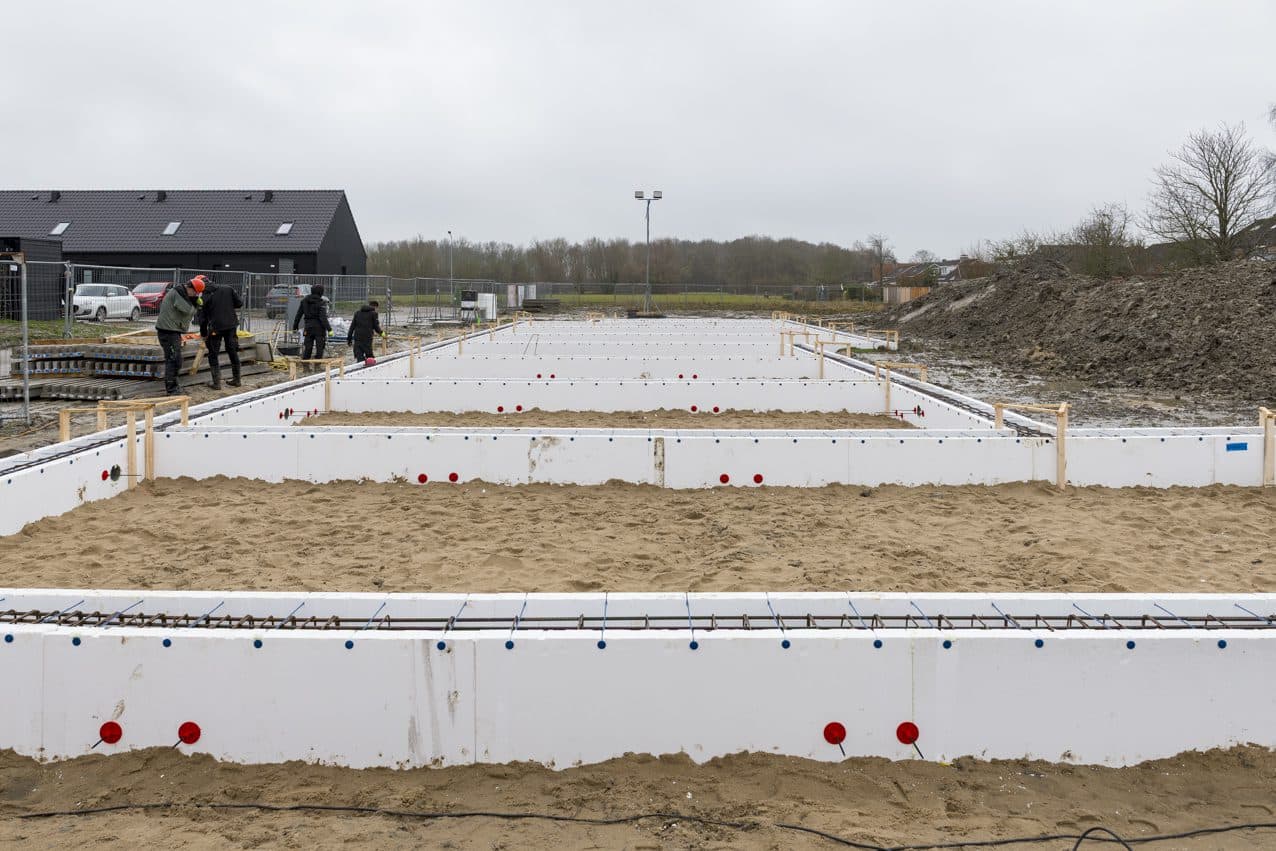
Casting foundations often remains a time-consuming and labour-intensive job on site. A permanent foundation formwork made of expanded polystyrene (EPS) addresses this by bringing speed, dimensional stability and insulation together in a single product. The formwork stays in place after pouring and immediately takes on an insulating role.
Fast installation
The biggest advantage lies in the simplicity of assembly. The formwork is lightweight and quick to position, reducing the number of actions required on site. Because props and bracing frames are not needed, a crew can work faster and relies on fewer aids. The use of base brackets is also limited, which further simplifies preparation.
Insulation and finish
Since the EPS remains a permanent part of the structure, a continuous layer of insulation forms around the foundation. This helps prevent thermal bridges, a recurring weak spot at the junction between the foundation and the rising structure. For a building's energy performance, that is a significant benefit.
The system's dimensional stability also ensures a clean end result. The formwork keeps its shape during pouring, so deviations stay small and the foundation remains accurately within the intended measurements.
Relevance for construction
For contractors and installers, this kind of solution ties in with two current priorities: shortening build times and improving insulation values. The combination of less labour, less supporting material and better thermal performance makes the system attractive for both residential and commercial construction.
- Speed: installation without props or bracing frames
- Less auxiliary material: reduced use of base brackets
- Insulation: a continuous layer that counters thermal bridges
- Quality: dimensionally accurate with a neat finish
Anyone looking to organise foundation work more efficiently without compromising on insulation and precision will find a permanent EPS formwork a practical addition to the existing toolkit.